Back to Tips & Articles
Understanding your Child's Attachment Styles
Tips & Articles
Family Support
Parenting Support
02 Apr 2026
Did you know that early childhood experiences and relationships have the greatest impact on how people perceive the world and react to life's challenges? Discover the four types of attachment styles and learn how to parent a secure child!
Relationships fostered from young usually have the greatest impact on how people perceive the world and react to life's challenges. Growing up and experiencing life's adversaries also changes the way children interact with others.
In a theory written by psychologist Dr John Bowlby, he said that a child's life experiences shape the way people show intimacy later in life. He came up with the term "attachment styles” to classify people who have certain characteristics based on their upbringing or other circumstances.
What are the different attachment styles and how can parents raise their children to help them feel loved and secure?
TYPES OF ATTACHMENT STYLES
Secure: Children with a secure attachment style have stable connections with others and trust their loved ones. They can exist in a loving relationship with someone without losing their individuality or becoming overly dependent [1]. A child with a secure attachment style often receives adequate love and support from caregivers, turning them into confident, self-assured individuals.
Fearful (Insecure): A fearful attachment style often forms when children receive love from an inconsistent source [2]. For example, a parent who gets overly involved one moment and becomes distant the next causes a child to become distrustful in response. The child becomes reliant on external validation and depends on others as a result. People with this attachment style tend to worry about their loved ones abandoning them due to low self-esteem [2].
Avoidant (Insecure): A child with the avoidant attachment style intentionally chooses not to be in situations where emotions are involved. This usually stems from a parent or caregiver who showed disinterest in the child's life, thus making the child more aloof. Sometimes, an avoidant attachment style can result from the child's needs being ignored outright. It causes children to fear intimacy or think that they can never get the emotional validation they need from a loved one as they grow older.
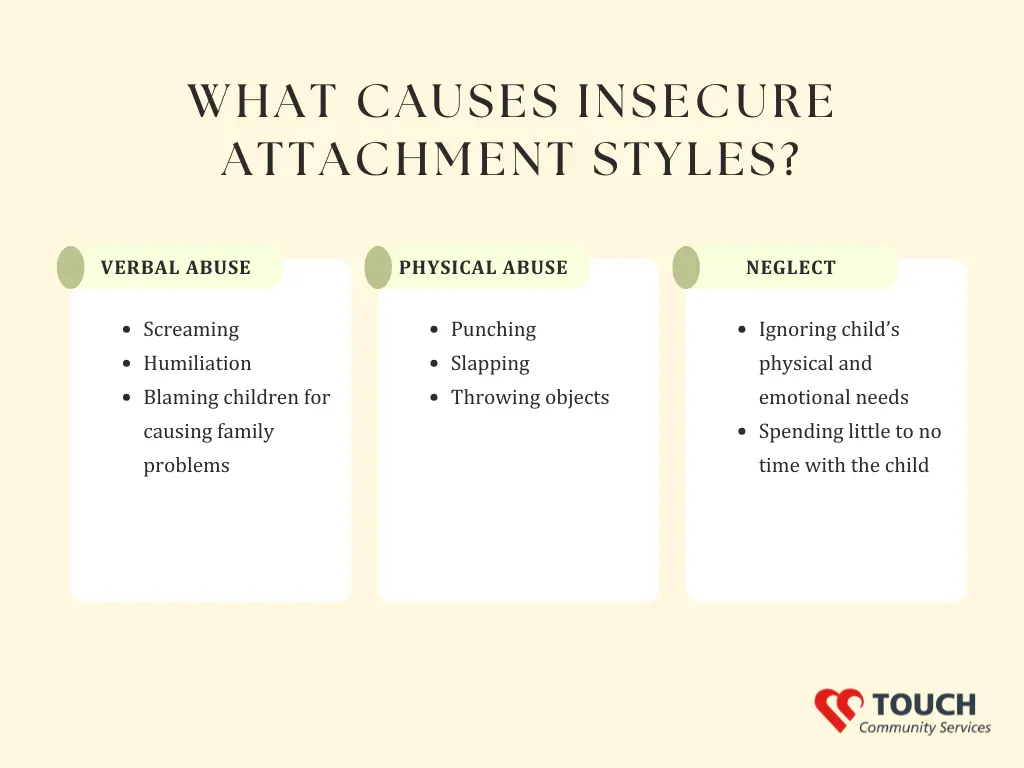
Fearful-Avoidant (Insecure): This is a combination of the fearful and avoidant attachment style. A child with this combination fears forming connections with others but wants to be a part of the community at the same time [3]. These contradicting needs are usually caused by unstable family dynamics such as domestic abuse [4].
Parents largely contribute to a child's attachment styles and behaviour as an adult. However, sometimes negative reinforcement from a parent is done subconsciously due to the lack of awareness [5].
With these points in mind, how can parents nurture their children to have a secure attachment style?
HOW TO PARENT A SECURE CHILD
Provide your child with reassurance: Children often turn to their parents for safety and comfort, especially in stressful situations. For example, when your child confides in you about friendship problems in school, do not be so quick to dismiss their feelings. Instead, tell them that you will always help them through life's challenges. Another form of reassurance that a parent can provide for their child is the promise of always giving food, shelter, love, and support no matter what happens [5].
Meet your child's emotional needs: Children learn how to self-soothe based on a parent's response to their distress. As such, parents should be present in their child's life to give comfort and help the child feel safe to explore the world on their own [5]. Meeting these emotional needs earlier fosters a child's independence and self-esteem.
Make your child feel valued: It is easy for parents to get carried away with the child's achievements rather than their personal attributes, given that we are in a society that emphasises academic growth. Your child needs to know that you value them for who they are as a person [5], their unique personality beyond just their grades or academic achievements. Nurture your child's best character traits and engage in meaningful bonding activities that will make your child feel more secure in their relationship with you. This way, your child grows into a confident adult who knows their worth and can contribute to society meaningfully.
Do you want to empower your parenting journey and be equipped with useful tools and resources? Find out more about our parenting workshops here.
TOUCH Parenting aims to strengthen parent-child relationships by providing parents with relevant parenting resources through every stage of their parenting journey. It conducts informative talks and workshops which empower parents with knowledge on preparing for and raising a new-born, navigating the digital age with their child, parent-child communication, and nurturing resilient children and youths. It is also appointed by the Ministry of Social and Family Development as the Parent Support Provider (PSP) for Primary and Secondary schools in Singapore.
Sources
1. Gonsalves, Kelly. “Your Childhood Can Affect Your Adult Relationships: Attachment Theory, Explained.” Mindbodygreen, 28 June 2022, https://www.mindbodygreen.com/articles/attachment-theory-and-the-4-attachment-styles
2. Cafasso, Jacquelyn, and Timothy J Legg. “Anxious Attachment: Signs in Children and Adults, Causes, and More.” Healthline, Healthline Media, 14 Nov. 2019, https://www.healthline.com/health/mental-health/anxious-attachment#management
3. Agbaria, Qutaiba, et al. “The Association between Attachment Patterns and Parenting Styles with Emotion Regulation among Palestinian Preschoolers.” SAGE Open, vol. 11, no. 1, 2021, p. 215824402198962., https://doi.org/10.1177/2158244021989624
4. Holland, Kimberly, and Timothy J Legg. “Fearful Avoidant Attachment: What This Means in Relationships.” Healthline, Healthline Media, 11 Dec. 2019, https://www.healthline.com/health/mental-health/fearful-avoidant-attachment
5. Buescher, Lindsay. “Fearful Avoidant Attachment - How It Develops in Childhood.” Attachment Project, 19 Feb. 2022, https://www.attachmentproject.com/blog/fearful-avoidant-attachment-in-childhood/