Back to Tips & Articles
Strengthening your Marriage after an Extramarital Affair
Tips & Articles
Marriage Support
Counselling
Mental Wellness
06 Apr 2026
Navigating the aftermath of infidelity is one of the most challenging things a couple can face. In this article, we explore common signs of infidelity and share how couples can begin the process of healing and rebuilding their relationship.
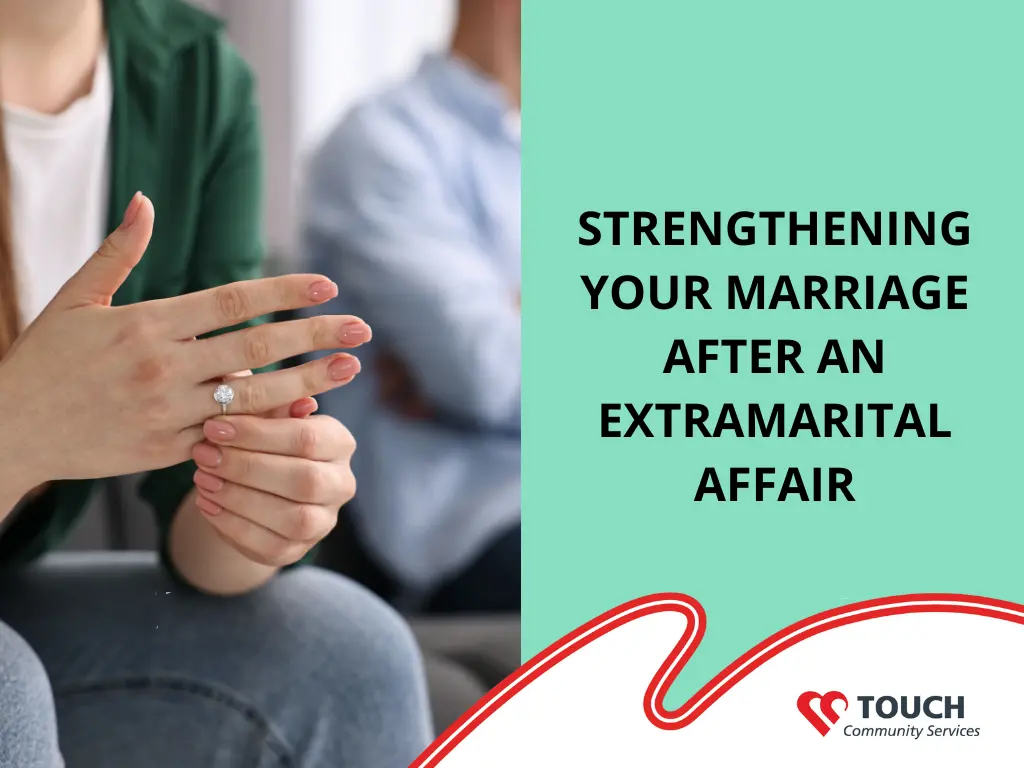
Discovering that your spouse may be unfaithful can be painful and distressing. When trust is shaken in a marriage, many couples are left wondering what steps to take next.
If you suspect that your spouse may be unfaithful, the following insights may help you better understand the situation.
SIGNS THAT YOUR SPOUSE MAY BE UNFAITHFUL
Here are some common signs that may indicate an affair.
Protective over personal devices: Your spouse might get jumpy and close messaging apps or cover their screens when you enter the room. If your spouse used to share their passwords but suddenly stopped [1], your spouse could be contacting their affair partner.
Defensive when confronted: Your spouse may react negatively when you ask them whether they are seeing other people. Some partners might call you insecure when confronted about having an affair or might even accuse you of having an affair instead, when that is not the case.
Loved ones avoid talking about your marriage: You might be the last person who finds out about your spouse’s affair [2]. Your friends may choose not to tell you for fear of overstepping their boundaries and getting involved in someone else's marriage. Your family could also know about the affair and may become overly nice to conceal their guilt.
However, it is also important to note that these signs do not necessarily mean that your spouse is unfaithful. In some cases, a spouse may be unfaithful without showing any obvious signs. Regardless of the situation, a marriage deserves attention and care, and addressing underlying issues is a step towards clarity and healing.
HOW TO RECONCILE AFTER DISCOVERING YOUR SPOUSE'S AFFAIR ?
While hard, it's possible to reconcile after an affair. Here are some tips that may help.
Identify points of contention: Some spouses cheat when there is a complete breakdown in communication or when the marriage does not meet their emotional needs. Depending on the severity of your spouse's affair, it might be hard to recover on your own. It is best to seek help from a counsellor who can help to address the root cause of your spouse's infidelity.
Expand your support network to include an experienced counsellor who can help you and your partner on this journey. TOUCH Counselling and Psychological Services offers counselling for couples to work through relationship issues and forge stronger bonds. You may call the TOUCHline at 1800 377 2252 (Mondays to Fridays, 9am to 6pm) to speak with a counsellor.
Give each other time and space: After discovering your spouse's infidelity, you might feel strong emotions such as anger and betrayal. Avoid lashing out at your partner, especially in front of children. Tell your spouse that you need time alone to process everything. You can arrange to sleep in a separate room or stay with a relative for the time being.
Maintain open communication [3]: Both parties need to be honest with their feelings. If your spouse comes clean about having an affair, they need to assure you that it will never happen again. You also have to make it clear that you need time to forgive them. Avoid sharing any details about the affair, such as how long it lasted, until both people are ready.
Fill your spouse’s love tank: A love tank is an invisible gauge of how emotionally fulfilled you are in a relationship. To begin rebuilding, identify your spouse’s primary love language or how they enjoy receiving affection — whether it’s words of affirmation, acts of service, or physical touch. Another way you can fill their love tank is to dedicate some time alone with your spouse to go on dates or learn something new together.
Solve problems as a couple: Difficult conversations with your spouse are inevitable during this time. Choose to address any issues together instead of fighting and to approach them as working towards healing and recovery as a couple. Share your honest thoughts with your spouse to avoid any misunderstandings, while creating safe space for your spouse to do the same.
Care for your needs: As you work to reconcile the marriage, it’s also important that you look after your physical, emotional and mental well-being by carving time out for self-care or seeking support from family and friends. Not all cases of infidelity have to end in divorce or separation. Some couples who choose to stay after an affair find that their marriages become stronger with time. Even after you have forgiven each other, you and your spouse must continue maintaining the relationship. This way, you can prevent future instances of infidelity as both of your emotional needs are met.



TOUCH Marriage Support aims to enrich marriages to build a strong foundation for families. Through a range of holistic programmes led by experienced marriage educators and counsellors, TOUCH Marriage Support prepares young couples for marriage, strengthens spousal relationships, guides couples through conflict resolution, and empowers couples to navigate and cope with the stressors and challenges which they may face in their marriage.
TOUCH Counselling and Psychological Services Group (TCPSG) runs personalised therapy and counselling programmes to empower individuals to be more resilient, cope with daily living, and rise above their circumstances. Through its Supportive Intervention Care Model which comprises Community Care, Private Care and CareTech, TCPS ensures that individuals and families from all backgrounds receive timely care curated to their specific needs. Its expert team of counsellors, psychologists and psychiatrists specialise in areas such as, psychological assessment and diagnosis, trauma therapy, suicide prevention, youth mental wellness, and digital addiction intervention and affair/divorce recovery.
Sources
1. Stritof, Sheri. “8 Signs That Could Mean Your Partner Is Cheating.” Verywell Mind, Verywell Mind, 5 Nov. 2021, https://www.verywellmind.com/warning-signs-your-spouse-is-cheating-2300652
2. Weiss, Robert. “10 Signs Your Spouse Is Cheating.” Psychology Today, Sussex Publishers, 10 Dec. 2018, https://www.psychologytoday.com/sg/blog/love-and-sex-in-the-digital-age/201812/10-signs-your-spouse-is-cheating
3. “Infidelity: Mending Your Marriage after an Affair.” Mayo Clinic, Mayo Clinic, https://www.mayoclinic.org/healthy-lifestyle/adult-health/in-depth/infidelity/art-20048424
4. Simpson, Stacie. “How to Keep Your Partner's Love Tank Full.” FamilyToday, BNMedia, LLC Https://Www.bnmediallc.com/, 15 Apr. 2017, https://www.familytoday.com/relationships/how-to-keep-your-partners-love-tank-full/
5. “The Love Tank Factor - How to Make Your Relationship Last Forever?” Health & Healthier, 2 July 2022, https://healthandhealthier.com/love-tank/